
Natural vs. Unnatural
Unlike Tim I was not a huge fan of look to windward. I can't place my finger on anything specific--I just felt like the weapons pornesque descriptions of people things places (people that are places and things occasionally) could go on forever--and I tend to forget those parts of books pretty quickly anyway.
Back to my post. I hinted at this idea in my last post (below), but there is a certain unnatural assumption made about humanity--we, for some reason or another, view our selves as supernatural, able to manipulate and destroy that as it should be. This is a trait we seem to uniquely identify with ourselves and tend to remove from the other (even, often, when the other is human). Look to Windward had, to me, the most reasonable others because his others seemed capable of this same act of a supernatural nature. Yes, they are also unique in both their culture and physiological makeup (I will admit a giant living aware plant dirigible is pretty unique other), but unlike so many other examples of alien species we have explored the species of the Culture's universe are uniquely unnatural--they manipulate the world around them, ostracize members of their society, and have a knack for being destructive towards one another.
Again, I will grant that it was still the humans role to interfere in everything (as we love to do when serving as a hegemonic power), and the culture seemed (in a very human way) to suggest that they were solely responsible for the problems caused by this interference (you can read my previous post to see where I lay the blame for civil wars and revolutions supposedly caused by outside forces). This self as the only truly aware peoples is something we do even with other humans though, so I would not read much into it (Columbus describing the aboriginal americans along with the plants and birds--although after reading this novel you never know maybe the plants had names).
No, Bank's others are so oddly believable because they are so...well human...in that we use human to describe that odd woman folly we love to praise. They are human--disconnected with their environment, manipulative of the afterlife, destructive towards each other in a way the aliens of Alien, The Sparrow, Enders Game, and Just about anything else we covered this semester were not.
Showing posts with label Zakahi. Show all posts
Showing posts with label Zakahi. Show all posts
Sunday, May 4, 2008

Reflection on God's Children
I seem to have a knack for doing these things at the last possible moment. This time I have a pretty good excuse though; I just had no clue what to blog about--reading Windward however, I came to reconsider a point that was brought up in class and reiterated by Kristen. This is the idea of outside influence as the cause of social turmoil/civil war/revolution/etc. In class I went along with the suggestion that ultimately without Sophia the Runa would have not revolted. While, as I will explore below, this may have been the case on Rakaht I am not sure this is the rule. The outside influence and or superior leader concept is one that is cited rather frequently to explain large shifts in civilizations and societies. I am becoming less convince (especially after thinking about this while reading banks) that these outside influences can ever be considered the cause of societal shakeups (I explain my reasoning with regard to the Runa in a moment), instead, I would argue that while the sudden presence of the other may serve as a catalyst to a specific reaction the actual cause of this reaction was already present in the society. I am not sure that the mere introduction of someone with a different perspective is enough to completely transform a society.
Admiral Perry/ the forced introduction of the west is largely credited with the shakeup of the traditional feudal system in Japan. Suddenly the Japanese realized just how "backwards" they were and felt the need to completely reinvent themselves. If we look more closely, however, the makings of an unstable society were already there--misapportioned wealth, a largely superfluous military class, and an emergent and increasingly powerful merchant class are all things that are also associated with the French Revolution and the slow demise of feudalism in Great Britain. Neither of these societies saw the sudden introduction of an outside force, yet both transformed (one rather quickly and violently) there is nothing to indicate that without Perry presence the Japanese would not have been set on a similar course.
A more extreme example is that of the overthrow of the Aztecs by Cortez. I will go so far as to suggest it was not Cortez's doing, but the internal characteristics of an unstable empire. The Romans, without the assistance of a funny looking god-like ruthless Spaniard managed to fall apart because of some of the same issues that were beginning to plague the Aztecs--Overreaching in conquest, a large number of seditious conquered peoples, and a system of ruler selection which was not designed to pick the best individual for the job (sound like any empires you can think of now). I again argue that if Cortez/Columbus/stupid spanish had not appeared the Aztec Empire may have fallen apart (either quickly or slowly) of it's own volition.
I realized that over the course of simply writing this post I have once again switched positions on my view of the Runa revolt I once again do not believe that it would have been possible without the Jesuit presence, but I believe this is because the situation was designed to mimic the ideal--the outside influence concept was taken to the extreme in this circumstance. The civilization created by Russel was so perfect for the scenario that it could have played out no other way. The VaRakaht civilization was so perfectly constructed as a ecologically feudal society that there seems to be no way of destroying it internally. It reminds me of the mistake so often made in assuming that the actions of Humans are "not natural" we assume we are somehow capable of destroying the balance of the planet because of our Moral ability to folly or something of the sort. In the same way she seems to suggest the runa and Janata are inhuman---truly other--in that they do not share this quality. Only humans were able to step in an disrupt this balance previously the society was perfect (exactly opposite of what things should really be or even how Banks portrays the Chel civil war). Not only that, but the society was also perfectly set up to be formerly balanced yet completely susceptible to outside influence. The social mimicry of the Runa makes the whole thing spread like wildfire. Yet in most earthly examples of the outside influence the civilization is already messed up enough that the slightest little disturbance from the other is enough to bring it down. THIS IS NOT THE CASE ON RAKAHT. THE SOCIETY GOES FROM PERFECTLY STABLE TO COMPLETELY INSTABLE IN JUST A FEW YEARS.
Admiral Perry/ the forced introduction of the west is largely credited with the shakeup of the traditional feudal system in Japan. Suddenly the Japanese realized just how "backwards" they were and felt the need to completely reinvent themselves. If we look more closely, however, the makings of an unstable society were already there--misapportioned wealth, a largely superfluous military class, and an emergent and increasingly powerful merchant class are all things that are also associated with the French Revolution and the slow demise of feudalism in Great Britain. Neither of these societies saw the sudden introduction of an outside force, yet both transformed (one rather quickly and violently) there is nothing to indicate that without Perry presence the Japanese would not have been set on a similar course.
A more extreme example is that of the overthrow of the Aztecs by Cortez. I will go so far as to suggest it was not Cortez's doing, but the internal characteristics of an unstable empire. The Romans, without the assistance of a funny looking god-like ruthless Spaniard managed to fall apart because of some of the same issues that were beginning to plague the Aztecs--Overreaching in conquest, a large number of seditious conquered peoples, and a system of ruler selection which was not designed to pick the best individual for the job (sound like any empires you can think of now). I again argue that if Cortez/Columbus/stupid spanish had not appeared the Aztec Empire may have fallen apart (either quickly or slowly) of it's own volition.
I realized that over the course of simply writing this post I have once again switched positions on my view of the Runa revolt I once again do not believe that it would have been possible without the Jesuit presence, but I believe this is because the situation was designed to mimic the ideal--the outside influence concept was taken to the extreme in this circumstance. The civilization created by Russel was so perfect for the scenario that it could have played out no other way. The VaRakaht civilization was so perfectly constructed as a ecologically feudal society that there seems to be no way of destroying it internally. It reminds me of the mistake so often made in assuming that the actions of Humans are "not natural" we assume we are somehow capable of destroying the balance of the planet because of our Moral ability to folly or something of the sort. In the same way she seems to suggest the runa and Janata are inhuman---truly other--in that they do not share this quality. Only humans were able to step in an disrupt this balance previously the society was perfect (exactly opposite of what things should really be or even how Banks portrays the Chel civil war). Not only that, but the society was also perfectly set up to be formerly balanced yet completely susceptible to outside influence. The social mimicry of the Runa makes the whole thing spread like wildfire. Yet in most earthly examples of the outside influence the civilization is already messed up enough that the slightest little disturbance from the other is enough to bring it down. THIS IS NOT THE CASE ON RAKAHT. THE SOCIETY GOES FROM PERFECTLY STABLE TO COMPLETELY INSTABLE IN JUST A FEW YEARS.
Tuesday, April 22, 2008
Substinative
I wonder how history might have been different if after a few years with Columbus missing some other explorer sets out to the west and finds him alone as a prostitute? I also wonder if he would have had similar difficulties overcoming the only conclusion that he could possibly have reached which is GOD wanted him to be raped? I propose that, instead, Columbus would easily have seen that it and little to do with God and much more to do with Godless barbarians.
I say this, hoping to turn it around as well, what would Sandoz have done in Columbus' situation. Would he have presumed the perfect equality of everyone he came in contact with, and assumed that he could quickly understand not only their language, but their society and culture as well? Would he have found himself prey to some hungry cannibal tribe?
Both The Sparrow and Todorov seemed to express to opposite ends of the spectrum when it comes to dealing with the other. In Children of God, Russel makes a distinct effort to convey and ideal of something in the middle. Not the same, but not unequal. Equal but different. Somehow both Columbus and Sandoz are closedminded explorers. Where both expeditions went wrong where they could have improved their crew lists would have been to be willing to accept something not expected, or to have brought someone along with the capacity to beleive that not all societies not all peoples are exactly the same.
I wonder if, given a sense of post modernism, Columbus would have been able to handle his interactions with aboriginal americans in a positive manner.
I say this, hoping to turn it around as well, what would Sandoz have done in Columbus' situation. Would he have presumed the perfect equality of everyone he came in contact with, and assumed that he could quickly understand not only their language, but their society and culture as well? Would he have found himself prey to some hungry cannibal tribe?
Both The Sparrow and Todorov seemed to express to opposite ends of the spectrum when it comes to dealing with the other. In Children of God, Russel makes a distinct effort to convey and ideal of something in the middle. Not the same, but not unequal. Equal but different. Somehow both Columbus and Sandoz are closedminded explorers. Where both expeditions went wrong where they could have improved their crew lists would have been to be willing to accept something not expected, or to have brought someone along with the capacity to beleive that not all societies not all peoples are exactly the same.
I wonder if, given a sense of post modernism, Columbus would have been able to handle his interactions with aboriginal americans in a positive manner.
Tuesday, April 15, 2008
Substanitive Conquest
Let me preface this by saying that I do not like discourse analysis (sorry Professor) also, I have not slept in a while, and that you should probably not read this if you have not read Children of God because I make no guarantees that I will not mention it in my post. Also, I am going to start with a rant about how Cortez knew what he was doing unlike the mission, and then try to move on to comparisons between the mindsets of Columbus and the two missions to Rakat. Finally, I hope to have another little rant about aesthetics.
To begin I look to the chapter Cortez and signs. Over and over again it reiterates how Cortez was constantly looking for more information and not trusting anyone. Why did our group not do this. Granted, they had a more peaceful intent than did Cortez, but at least he knew not to be a fool about things. We have, on a number of occasions and a number of blog posts suggested that they cannot be blamed for something we can spot as an error in hindsight. I argue, however, that Cortez's desire to learn and understand Montezuma and the Aztecs is essentially the same idea and if he thought to do it Emilio Sandoz and Company could have been able to do it as well.
Before moving on to columbus I also feel the need to mention Cortez's position in overthrowing the Aztecs as not being all that different from the position of Sofia as she lead the Runa against the Ja'anata. The book notes how Cortez's army is essentially some spanish Cavalry and a lot of native foot soldiers who had been oppressed by the Aztecs. We even see some aspects of Aztec determinism in Ja'anata life with regards to birth essentially serving as destiny.
If one puts the two Sandoz missions to Rakat together you total the misc. reasons for which Cristobal wanted to discover as well. The second mission covers wealth while the first one looks as beauty, learning, and the glorification of God. Columbus and the Jesuits share a certain presumptive success/fatalistic outlook on the mission. Both seem to believe God is leading them exactly where they want to go. If I did not know better I would say the Russell has read this piece.
To begin I look to the chapter Cortez and signs. Over and over again it reiterates how Cortez was constantly looking for more information and not trusting anyone. Why did our group not do this. Granted, they had a more peaceful intent than did Cortez, but at least he knew not to be a fool about things. We have, on a number of occasions and a number of blog posts suggested that they cannot be blamed for something we can spot as an error in hindsight. I argue, however, that Cortez's desire to learn and understand Montezuma and the Aztecs is essentially the same idea and if he thought to do it Emilio Sandoz and Company could have been able to do it as well.
Before moving on to columbus I also feel the need to mention Cortez's position in overthrowing the Aztecs as not being all that different from the position of Sofia as she lead the Runa against the Ja'anata. The book notes how Cortez's army is essentially some spanish Cavalry and a lot of native foot soldiers who had been oppressed by the Aztecs. We even see some aspects of Aztec determinism in Ja'anata life with regards to birth essentially serving as destiny.
If one puts the two Sandoz missions to Rakat together you total the misc. reasons for which Cristobal wanted to discover as well. The second mission covers wealth while the first one looks as beauty, learning, and the glorification of God. Columbus and the Jesuits share a certain presumptive success/fatalistic outlook on the mission. Both seem to believe God is leading them exactly where they want to go. If I did not know better I would say the Russell has read this piece.
Monday, April 14, 2008
Beauty and the Other

I want to return to return to the idea of beauty in defining and understanding the other Schmitt notes "The political enemy need not be Morally evil or aesthetically ugly," but I am beginning to question if, for all practical applications, this is actually true. We only briefly touched on this in class last week, but I suspect we will spend at least some time on it tomorrow (given it's apparent importance to Columbus), but I believe it is nearly impossible for humans to separate the two. Exhibit A: the propaganda poster above--what sort of message would it have conveyed if the soldier looked like the upstanding young man who was more likely to be wearing that uniform than a large ugly Gorilla? In the same sense, what would have been the reaction of the people of earth if the Reshtar's music had sounded a little less beautiful and a little more like rape. The prince is never really a prince when he looks like a frog, and the Wicked Witch can always trick the hero if she disguises her ugly worts. We keep using biblical allusions (specifically Job) see Sarah below. I think a story with even more ties is the Odyssey--Odysseus who, during the Trojan war is watched over and guided by Athena, is finally led astray by the Gods, left to roam for years before getting home. Specific to my point in this post is his encounter with the Sirens who's beautiful song is meant only as a lure. someone needed to lash Emilio Sandoz to his mast.
Monday, April 7, 2008
The Sparrow
This will be the third time today I have tried to write this (sorry it's a little late). Last time it was about 5:00 and almost as soon as I had the text box open I leaned back and feel asleep. That reminds me of the first time I read the book, I was about 3/4 of the way through (maybe even a little farther--just when Emilio finds out nothing he sent back was published) when midnight brought with it the close of my favorite coffee shop--where I happened to be reading. I was, however, so involved in the book that I had to walk across the street to Village Inn (a classy version of Dennys) and finally finished around 2:00 in the morning (just in case you were interested).
What kept me involved then, and many of you have commented on, is the religious/spiritual journey of Emilio, Job, or, the man who God gave everything to and then took that plus interest. I too found this especially moving--being an atheist who was raised Catholic. My second reading through--for this class--however, forced me to pay attention to something Scott touches on briefly in his post and that is the question of the other. Schmitt makes an interesting note that the friend enemy distinction is not a question of beauty, and it seems Russel almost directly confronts the idea of how beauty impacts our perception of the other. There are numerous times on earth, before they leave where it is pointed out that a race which creates such beautiful music must be good. I wonder what Sandoz thinks now. Once they are on the planet again, there is an alomst deliberate deception by Russel to lul her characters into a false sense of security because of the beauty of the VaRakahti--particularly the Runa.
I believe Schmitt would find the book especially pleasing, not because Sandoz is hirribly raped, but because the order/the mission seemed to confuse astetics (beauty v. ugly according to Schmitt) with the political. And while I don't believe the book was intended in this manner it could be easily read as a Science Fiction play on the follies of liberalsim.
If we take the idea we expressed early in class about science fiction being a means with which to critique society without doing so directly, yet more explicitly, drawing parallels between some alien or futuristic story and the problems of the world today. One could not outwardly criticize the ideals of modern liberal pacifism where friend and enemy becomes confused with civilized and uncivilized, democratic and undemocratic, good and bad. But if you create an alien world and have a group of explorers confuse Beauty and Ugly with Friend and Enemy then the situation becomes far enough detached that those criticisms are possible. They explicitly make the mistake of confusing the two and are explicitly rebuked for it. Again, I don't think that was the point, but it's a pretty intersting line of thought anyway.
What kept me involved then, and many of you have commented on, is the religious/spiritual journey of Emilio, Job, or, the man who God gave everything to and then took that plus interest. I too found this especially moving--being an atheist who was raised Catholic. My second reading through--for this class--however, forced me to pay attention to something Scott touches on briefly in his post and that is the question of the other. Schmitt makes an interesting note that the friend enemy distinction is not a question of beauty, and it seems Russel almost directly confronts the idea of how beauty impacts our perception of the other. There are numerous times on earth, before they leave where it is pointed out that a race which creates such beautiful music must be good. I wonder what Sandoz thinks now. Once they are on the planet again, there is an alomst deliberate deception by Russel to lul her characters into a false sense of security because of the beauty of the VaRakahti--particularly the Runa.
I believe Schmitt would find the book especially pleasing, not because Sandoz is hirribly raped, but because the order/the mission seemed to confuse astetics (beauty v. ugly according to Schmitt) with the political. And while I don't believe the book was intended in this manner it could be easily read as a Science Fiction play on the follies of liberalsim.
If we take the idea we expressed early in class about science fiction being a means with which to critique society without doing so directly, yet more explicitly, drawing parallels between some alien or futuristic story and the problems of the world today. One could not outwardly criticize the ideals of modern liberal pacifism where friend and enemy becomes confused with civilized and uncivilized, democratic and undemocratic, good and bad. But if you create an alien world and have a group of explorers confuse Beauty and Ugly with Friend and Enemy then the situation becomes far enough detached that those criticisms are possible. They explicitly make the mistake of confusing the two and are explicitly rebuked for it. Again, I don't think that was the point, but it's a pretty intersting line of thought anyway.
Tuesday, April 1, 2008
Political?
In contrast to what Sara suggested right below me I happen to like the fun philosophical way of defining terms endlessly. I did find myself a little bored by the section that defined everything political had previously falsely been identified with. The overarching concept of what it is to be political is something I had never thought of in such explicit terms before and something that made perfect since once I read it. The idea of political being the realm of defining friend and foe is an absolutely perfect description. I just wish my political science education was more directly focused on this specific issue. Seems to me political science should be more focused on defining political and means of understanding friend and foe as opposed to all the boring (ok, so I like it) voting behavior stuff we do study.
Thursday, March 27, 2008
The Genes (Jeans?) of Society
Scott makes an interesting case for why the offensive posture taken by the I.F. and in a moment I want to try (just for the hell of it) to make the opposite case. First, however, I would like to make a modification to the initial idea proposed by Gaff about survival being in our genes to suggest instead the idea of societal genes--that essentially describe the nature of our society. It would be these genes Gaff is actually talking about. The strongest traits in cultures survive while the weaker ones die off. The mistake, of course, in Gaff reasoning with biological or social genes is the fact that he assumes our genes are the stronger ones--This is not always true.
I also believe a good argument can be made against the decision of the I.F. First, there is no reason to assume that we could beat the buggers at their homeworld--given this case we could have simply provoked another attack. Second, this left us totally defenseless should our ships have passed in space or something, while we had no idea about the overall strength of the bugger civilization. Third, it must be assumed that any commander capable of defeating the buggers in their turf would also be able to defend out turf--Ender, our weapon of choice, could perceivably serve either an offensive or defensive role. If, we assume that we must prepare for what is essentially the worst possible scenario in which it is possible to survive then leaving the fleet home would have been the best (if not the only) option. The only reason to send a fleet to attack if we assume that they are going to attack us soon would be one of vengeance, since without communication the deterrence idea of "if you kill us we will kill you" does not work.
I also believe a good argument can be made against the decision of the I.F. First, there is no reason to assume that we could beat the buggers at their homeworld--given this case we could have simply provoked another attack. Second, this left us totally defenseless should our ships have passed in space or something, while we had no idea about the overall strength of the bugger civilization. Third, it must be assumed that any commander capable of defeating the buggers in their turf would also be able to defend out turf--Ender, our weapon of choice, could perceivably serve either an offensive or defensive role. If, we assume that we must prepare for what is essentially the worst possible scenario in which it is possible to survive then leaving the fleet home would have been the best (if not the only) option. The only reason to send a fleet to attack if we assume that they are going to attack us soon would be one of vengeance, since without communication the deterrence idea of "if you kill us we will kill you" does not work.
Friday, March 7, 2008
V reflection
I am still not quite sure where to go with this, but I want to discuss V's motivations. I still can't figure out if V favored anarchy, or if he simply felt anarchy allowed him to do as much damage to those who had hurt him as possible. You can kill whoever you want in the land of do as you please. I think it's telling when V offers to avenge Gordon's life despite the fact that this would lend no assistance to his cause. If he were really interested in anarchy I think he would have kept his focus there.
I also continue to wonder just how much control V had over the situation. We bounced around this question a couple of times in class with regards to moral issues, but I wonder if planned out every single thing, knew how people would react and worked to create the "environment" that would cause that reaction, or if there was actually some element of chance or free will. Yes, V just put Evey in the right environment, but if he knew what would happen then he made the decision for her. It's especially telling that he controlled fate--he had the power to manipulate destiny, to predetermine how things would occur. In a sense, this is even greater power than Paul's as he could only see the future, while V writes the future.
I also continue to wonder just how much control V had over the situation. We bounced around this question a couple of times in class with regards to moral issues, but I wonder if planned out every single thing, knew how people would react and worked to create the "environment" that would cause that reaction, or if there was actually some element of chance or free will. Yes, V just put Evey in the right environment, but if he knew what would happen then he made the decision for her. It's especially telling that he controlled fate--he had the power to manipulate destiny, to predetermine how things would occur. In a sense, this is even greater power than Paul's as he could only see the future, while V writes the future.
Monday, March 3, 2008
Substinative-V
I really don't know where to start with V. I did not like the graphic novel format, the story was good, as was the dialog, but I could not seem to get into it because of the layout. I do think it could make a good movie though (I have to agree that the V movie already made did not live up to standard). I realize that having a main character is necessary, but I am still disappointed that all of these revolutionary tales seem to pass on this messianic belief in the importance of one extraordinary individual. This is not how real revolutions happen! It takes a movement led not bay a single individual, but by the sand of time and the structure of the current situation conspiring against the oppressive regime.
I also want to offer a comment on what I suspect Andrew will say. I don't beleive this is a story about the glory and greatness of Anarchy. In fact, I don't believe anarchy has much to do with the story at all. Instead, this is about the power of a vengeful person--the lesson to be learned is not that we need to allow anarchy so everyone can be free, but to be careful who we cross, and to choose not to oppress or abuse people if for not other reason than that they will probably get you back.
I also enjoy the various classifications of what is being done (terrorism, revenge, revolution, etc.).
Finally, I like the Sci Fi element in the supercomputer. I think it reveals the vulnerability of anyone who choose to rely on any one person or thing. It was an extraordinarily cynical message not that different from the individualistic statements Heinlein likes to make except, whereas in most Heinlein novels everyone is not really alone (I can think of one, maybe two exceptions), in V everyone is forced completely to rely on no one but themselves, and those who do seek comfort in relying on another (What's his names wife, Leader/the regime on Fate, Eve on Gordon, etc) only wind up regretting it.
I also want to offer a comment on what I suspect Andrew will say. I don't beleive this is a story about the glory and greatness of Anarchy. In fact, I don't believe anarchy has much to do with the story at all. Instead, this is about the power of a vengeful person--the lesson to be learned is not that we need to allow anarchy so everyone can be free, but to be careful who we cross, and to choose not to oppress or abuse people if for not other reason than that they will probably get you back.
I also enjoy the various classifications of what is being done (terrorism, revenge, revolution, etc.).
Finally, I like the Sci Fi element in the supercomputer. I think it reveals the vulnerability of anyone who choose to rely on any one person or thing. It was an extraordinarily cynical message not that different from the individualistic statements Heinlein likes to make except, whereas in most Heinlein novels everyone is not really alone (I can think of one, maybe two exceptions), in V everyone is forced completely to rely on no one but themselves, and those who do seek comfort in relying on another (What's his names wife, Leader/the regime on Fate, Eve on Gordon, etc) only wind up regretting it.
Thursday, February 28, 2008
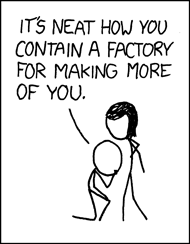
It happens that I was in the middle of the book when this was posted on xkcd last week(for anyone who does not regularly read xkcd you should). I think it offers interesting insight into the entire novel. I think, more than anything the book notes the unnatural nature, and consequences of, any man attempting to create life in his own image. The comic portrays a male desire or interest in this incapability, as well as our naivety to what it actually entails. The book shows the consequences of the Rabbi creating Joseph, Avram creating Yod, and God creating man (under the assumption that the destroyed, dystopiate world is the consequence of God creating man).
I will propose a biblical status for personhood (something I don't normally do, but I think it will be fun for this book)--an understanding of good and evil (morality). I suggest that Adam and Eve are not people until they eat the fruit, much like Joseph and Yod are not really people until the begin to understand good, evil , and morality, and children gain personhood as they learn a greater understanding of this.
What God, Avram, and Rabbi failed to realize is that one cannot create a something in our own image, with a high level of consciousness, without them grasping an understanding of these things. Piercy seems to contend that women do understand this, and understand the burden for emotional and moral development of their children.
Friday, February 22, 2008
Reflection
In all honesty I got a little bored with our Messiah discussion. It seemed to become more about semantics than anything else. This may be a personal bias of mine, I don't really like the idea of Messiahs. It bothers me when oppressed peoples come to the conclusion that only a destined person with superhuman abilities is capable of saving them when, in fact, all they have is a collective action problem. A good story would be about how the freemen recognized their own potential, stopped waiting for the Lisan and overthrew the Harkonnens themselves.
On to Weber.
I was a little hesitant to admit this in my substantive piece, but I loved Weber's lecture. While it does get a little boring in the middle I thought it was perfectly designed to break the spirit of the idealist little students he was giving it to. Oh how I wish some well known politician who AU students adore would come to campus and give a similar speech. I may be putting my own spin on this, but the end of the lecture lays out a Philosophy that I have been preaching for a while now in contrast to Chris' "practice vs. theory" I believe it is better described as, Idealism vs. Realism.
Here's a clip of the West Wing to explain. Here Leo acts with an ethic of responsibility while the President an ethic of conviction. The President is forced to either Kill a murderer or follow the law.
It's about considering the result of what any given decision will have and recognizing that the more ethical more moral decision is not the one that is "right" or "just" in the immediate sense, but in the long run.
On to Weber.
I was a little hesitant to admit this in my substantive piece, but I loved Weber's lecture. While it does get a little boring in the middle I thought it was perfectly designed to break the spirit of the idealist little students he was giving it to. Oh how I wish some well known politician who AU students adore would come to campus and give a similar speech. I may be putting my own spin on this, but the end of the lecture lays out a Philosophy that I have been preaching for a while now in contrast to Chris' "practice vs. theory" I believe it is better described as, Idealism vs. Realism.
Here's a clip of the West Wing to explain. Here Leo acts with an ethic of responsibility while the President an ethic of conviction. The President is forced to either Kill a murderer or follow the law.
It's about considering the result of what any given decision will have and recognizing that the more ethical more moral decision is not the one that is "right" or "just" in the immediate sense, but in the long run.
Monday, February 18, 2008
Weber Substinative
I found the Weber lecture quite hard to find (I finally got it out of the library reserve desk), and especially interesting when considered either in the context of all of my Politician friends (some who live for and some who live from politics) or in the context of Dune.
By far my favorite part of the reading came at the end (at least in the context of Dune). As a political leader Paul could see the consequences of his actions, leading to an interesting dilemma within Weber's ethical paradox between ethics of responsibility and ethics of conviction. Ultimately, Paul's actions lead to a lot of death, but Paul does everything he can to avoid this. Is he, in fact, an ethically perfect Character?
By far my favorite part of the reading came at the end (at least in the context of Dune). As a political leader Paul could see the consequences of his actions, leading to an interesting dilemma within Weber's ethical paradox between ethics of responsibility and ethics of conviction. Ultimately, Paul's actions lead to a lot of death, but Paul does everything he can to avoid this. Is he, in fact, an ethically perfect Character?
Saturday, February 16, 2008
Reflection/Dune/Destiny/Social Science
It occurred to me that our class discussion was a little odd. Somehow we seemed to center in on what could be called literary themes as opposed to social science ones. I have come to wonder if Dune really falls into the definition of "science fiction" we outlined at the beginning of class. Dune, much like Star Wars, seems to be a myth, more a story of a Messiah than a a story about how we deal/interact with aliens, robots, the future, etc. I believe we could have told the same story if we set it in the middle ages or a twisted version of ancient Rome. Sure there are laseguns, spaceships, and atomics, but there is nothing particular about these devices that propels the story. The Bene Gisserit are just a strange group of nuns or drudis, the mentat well schooled generals, and the Guild a well organized merchant marine union. Perhaps it's this timelessness about the scenario that makes the story so good. We can all see how this galactic political scenario might come to pass, so that frees up the author to tell a good story about the boy who would break the whole thing down. Perhaps a better element in the book to discuss is whether or not we find it plausible for a single individual to tear down a political system or if it can only be done with special powers.
Monday, February 11, 2008
Too many possiblities
I have had a hard time deciding what to write in this blog post. Not because I can't think of anything, but because I can't seem to pick one of the hundreds of potential topics to discuss. I have, however, always been struck by the idea of the Missionaria Protectiva. The concept reminds me of Cortes' welcome as a God when he first came to the Americas. While their was no conceived plot to plant the idea of a religious prophet within the Aztec religious beliefs so that it could later be used to destroy the empire, the impact of the Aztecs' belief that Cortez was their long awaited prophet is undeniable.
The next interesting question, of course, is whether or not establishing within religious beliefs within a society is, in fact, within the realm of possibility in the "real world". Christianity already awaits the return of a messianic character but is it actually reasonable to try and be the second coming. What would it take to live up to any mythology. Would you have to be as foreign to a people as Cortes was to the Aztecs, funny colored with strange clothes, and wielding unkown weapons. Or is it possible to fulfill a prophecy--even a prophecy that was laid out for you to fulfill seems like an almost impossible task.
The next interesting question, of course, is whether or not establishing within religious beliefs within a society is, in fact, within the realm of possibility in the "real world". Christianity already awaits the return of a messianic character but is it actually reasonable to try and be the second coming. What would it take to live up to any mythology. Would you have to be as foreign to a people as Cortes was to the Aztecs, funny colored with strange clothes, and wielding unkown weapons. Or is it possible to fulfill a prophecy--even a prophecy that was laid out for you to fulfill seems like an almost impossible task.
Sunday, February 10, 2008
Reflection on 2/5
I have been pondering this post for a while now, and I am sad to admit I still have not come up with anything especially insightful to say. I think the format of Tuesday's class threw me off a little. For some reason I had a hard time getting my head around evaluating Stephanson's claims, at least not in the improvisational internet manner. It would be one thing to study speeches, opinion pieces, and articles in search of a trend supporting or disputing his claim, but the brief internet searching bothered me a little. Especially given the ease with which I could alter Wikipedia (My little chunk is now gone, so someone did fix the page). I do think Stephanson's piece has opened my eyes to just how disturbing our rhetoric must seem to other countries. It's hard to reason with people who believe themselves predestined to Global Congquest (or, at least Global Conquest light). Especially if we consider just how much the claims of Manifest Destiny mirror the claims of the Borg, again, the ideas we spread may be different, but our methods and rhetoric are exactly the same as the Borg.
Tuesday, February 5, 2008
We are the Borg...Resistance is futile.
It occurred to me about halfway through the book that the American destinarian determinism Stephenson describes, this inevitability of the spread of Anglo-Saxon civilization (Manifest Destiny if you prefer) is essentially the philosophy of the Borg. Much like the Borg American's have historically presumed that ourselves, our civilization, and our ideas, will prevail. The Borg have a certain nonchalant, matter of fact, attitude about the whole thing "resistance is futile" you may not be completely assimilated today, but eventually you will. This is the idea of manifest destiny, resistance to the spread of Americanism is futile you will be assimilated. There are numerous ways we come to this conclusion from rationalized social Darwinism to simply believing it is the will of god, but ultimately we believe that _________(insert current label for the ideal American trait here) will prevail.
Also like the Borg we make two interesting assumptions. The first is that we assume everyone wants to be assimilated. The Borg seem to figure that they are in such an ideal state of existence, that the way they live their lives is so much better than everyone else that everyone want to become part of the collective (oops, did I say Borg, I meant Americans). The second is that all other ways of living are inferior to our/the borg's way of existence. This ties in closely with the above idea, but the key is that this makes up for those groups who do not want to be conquered, allowing us to force ourselves upon them because they are essentially "children" and don't really know what they want.
I have to thank Dr. Jackson and the class for this insight. I have seen a huge number of political parallels in Star Trek, but had I not read this book with science fiction in mind this one may never have occurred to me. By giving the Borg a different ideology and making them the bad guys we are separated from them, there is no direct accusation of the US in the Borg's expansionist ideas, but the means and pretexts they use are essentially the same, destroying entire people's without even realizing the harm they are causing is essentially an American Ideal.
Also like the Borg we make two interesting assumptions. The first is that we assume everyone wants to be assimilated. The Borg seem to figure that they are in such an ideal state of existence, that the way they live their lives is so much better than everyone else that everyone want to become part of the collective (oops, did I say Borg, I meant Americans). The second is that all other ways of living are inferior to our/the borg's way of existence. This ties in closely with the above idea, but the key is that this makes up for those groups who do not want to be conquered, allowing us to force ourselves upon them because they are essentially "children" and don't really know what they want.
I have to thank Dr. Jackson and the class for this insight. I have seen a huge number of political parallels in Star Trek, but had I not read this book with science fiction in mind this one may never have occurred to me. By giving the Borg a different ideology and making them the bad guys we are separated from them, there is no direct accusation of the US in the Borg's expansionist ideas, but the means and pretexts they use are essentially the same, destroying entire people's without even realizing the harm they are causing is essentially an American Ideal.
Saturday, February 2, 2008
Guess I better write a reflection
I am not entirely sure what to write here. I must admit I was not particularly struck by anything we covered in class. I suppose the most interesting part of our discussion revolved around the idea of morality and mike. We seemed to lose track of the question itself, being sidetrack by the question of whether or not Mike's actions were morally reprehensible. We are struck with an interesting dilemma if we simply ignore what happened and ask in isolation, if Mike did something that we would consider, without argument or question, morally problematic, would he be responsible? Unfortunately, I don't think I have an answer, although the best answer I heard in class was to ask Mike.
There was another issue that came up in class that is also worth addressing that has to do with the exact definition of revolution and how it pertains to this society. At one point in class the argument was made that the revolution was, in fact, merely a Palace Coup, throwing off outside control. This makes sense as the idea was first proposed by Barrington Moore (this has given me a chance to dig out my copy of Moore, so I am quite excited) at the beginning of the third chapter of his book Social Origins of Dictatorship and Democracy. This is only goes to show how successful Heinlein was in modeling The Moon is a Harsh Mistress after the American Revolution as at the beginning of Chapter 3 in his book Moore is explaining why his book considers the Civil War to be the real revolution in the US as opposed to the revolutionary war. We pointed out in class that there was no society on the moon to fundamentally alter as everyone lived essentially equally. I think this is a result Heinlein's idealized version of the American Revolution (whereas after the real revolution there was a large amount of inequality). Reading through Moore, however, made me consider the future of this Moon world. Moore's work discuss' how after the revolution Yammerheads lead by Alexander Hamilton set to work introducing big government and industry to the New world, the inequality formed by having an agricultural society dependent on slave labor to the South and an Industrial economy to the north eventually leads to the Civil war which becomes the real social revolution in the US. One could foresee a similar future for the Moon following this novel. As industry slowly takes over the moon many traditional loonies are forced to the asteriods (the west) while the more stubborn ones stake out some section, but an economic policy might arise which threatens the farmer's way of life (say water use limits) and so there is war. Anyway, I suggest everyone pick up Moore and at least read the third chapter.
There was another issue that came up in class that is also worth addressing that has to do with the exact definition of revolution and how it pertains to this society. At one point in class the argument was made that the revolution was, in fact, merely a Palace Coup, throwing off outside control. This makes sense as the idea was first proposed by Barrington Moore (this has given me a chance to dig out my copy of Moore, so I am quite excited) at the beginning of the third chapter of his book Social Origins of Dictatorship and Democracy. This is only goes to show how successful Heinlein was in modeling The Moon is a Harsh Mistress after the American Revolution as at the beginning of Chapter 3 in his book Moore is explaining why his book considers the Civil War to be the real revolution in the US as opposed to the revolutionary war. We pointed out in class that there was no society on the moon to fundamentally alter as everyone lived essentially equally. I think this is a result Heinlein's idealized version of the American Revolution (whereas after the real revolution there was a large amount of inequality). Reading through Moore, however, made me consider the future of this Moon world. Moore's work discuss' how after the revolution Yammerheads lead by Alexander Hamilton set to work introducing big government and industry to the New world, the inequality formed by having an agricultural society dependent on slave labor to the South and an Industrial economy to the north eventually leads to the Civil war which becomes the real social revolution in the US. One could foresee a similar future for the Moon following this novel. As industry slowly takes over the moon many traditional loonies are forced to the asteriods (the west) while the more stubborn ones stake out some section, but an economic policy might arise which threatens the farmer's way of life (say water use limits) and so there is war. Anyway, I suggest everyone pick up Moore and at least read the third chapter.
Monday, January 28, 2008
Substantive 2/Frontier Mentality
I should preface this by saying that while I will not give The Moon the title of "my favorite book" it does carry the title of "my favorite book by my favorite author" Although the libertarian revolution is the most obvious topic of discussion for the piece, I prefer another set of ideas explored in the novel--the ideas of Space as the next frontier and the ideal of the frontier mindset.
While many other social science aspects of his books change, Heinlein constantly emphasizes the importance of humanity venturing beyond our planet. One of the ways he does this is by idealizing and giving superiority to the frontier mindset. Moon is no exception to this trend. The loonies, the ideal characters of this book, are characterized by their rugged cowboy/homesteader/49er individualism and dedication to hard work. He makes it quite clear that taking care of oneself should be your biggest concern. The one thing that never seems to quite fit with this mindset is the idea of a linear marriage, the existence of such highly complex and communal family units would seem to indicate a more social and communal state of living among the loonies as a whole, yet they are quite indiendent.
The revolution is quite interesting as well. I find the untility of mike to be especially interesting. Mike makes revolution infinitely simpler fro the loonies--his ability to control every aspect of life on the moon begs the rather dipressing question; would the loonies have been able to revolt at all?
While many other social science aspects of his books change, Heinlein constantly emphasizes the importance of humanity venturing beyond our planet. One of the ways he does this is by idealizing and giving superiority to the frontier mindset. Moon is no exception to this trend. The loonies, the ideal characters of this book, are characterized by their rugged cowboy/homesteader/49er individualism and dedication to hard work. He makes it quite clear that taking care of oneself should be your biggest concern. The one thing that never seems to quite fit with this mindset is the idea of a linear marriage, the existence of such highly complex and communal family units would seem to indicate a more social and communal state of living among the loonies as a whole, yet they are quite indiendent.
The revolution is quite interesting as well. I find the untility of mike to be especially interesting. Mike makes revolution infinitely simpler fro the loonies--his ability to control every aspect of life on the moon begs the rather dipressing question; would the loonies have been able to revolt at all?
Thursday, January 24, 2008
A Second Theory of the End of the World
After class I came to a second potential theory for the inclusion of the end of the world in The Time Machine. By including the end of the world he is suggesting the potential for a world without humanity--the key being that somehow we died out. I don't claim a strong understanding of the mind of a late 1800s Brit, but I would assume that they did not see the potential for the end of humanity. In a Post Atomic, post World War, world with our understanding of the rather fragile and small place we hold both on earth and in the universe it's quite easy to foresee a future that does not contain humanity. The section could have been intended to serve as a further call to action, suggesting that if trends continued as he (Wells) saw them humanity would come to an end. This would seem to agree with the other conclusions we reached about the book speaking to a kind of human pride, the idea that the current society in which he lived was not dangerous to countries, classes, individuals, etc., but to humanity as a whole--there can be no worse fate for a species than extinction and that was, perhaps, what Wells intended to draw our attention to.
On a side note: On a number of occasions in class the idea of the Murlocks being evil and Eloi being good, but I am not sure Wells' characterizations of the two fall into these distinct categories. Granted, during the story itself the Murlocks take on a barbaric nature and dark character, but during the time the Traveler spends pondering his theories about the future society the Murlocks are treated quite well. He holds exstensive sympathies for the Murlocks. Even after he realizes the "true" nature of the relationship, he recognizes a certain ironic justice in the idea that the formerly oppressed would rise up to sit as the oppressors, and since the book serves as a warning against complacency the Eloi, who do nothing and don't seem to care that they are being eaten, not the Murlocks, who retain a certain amount of ingenuity and craftiness, are the true evil in the story.
On a side note: On a number of occasions in class the idea of the Murlocks being evil and Eloi being good, but I am not sure Wells' characterizations of the two fall into these distinct categories. Granted, during the story itself the Murlocks take on a barbaric nature and dark character, but during the time the Traveler spends pondering his theories about the future society the Murlocks are treated quite well. He holds exstensive sympathies for the Murlocks. Even after he realizes the "true" nature of the relationship, he recognizes a certain ironic justice in the idea that the formerly oppressed would rise up to sit as the oppressors, and since the book serves as a warning against complacency the Eloi, who do nothing and don't seem to care that they are being eaten, not the Murlocks, who retain a certain amount of ingenuity and craftiness, are the true evil in the story.
Subscribe to:
Posts (Atom)